We’ve all done it. You set what seems to be a reasonable exam but then the average comes out to be an F grade and all the students start freaking out. The immediate call is to curve the scores up! I think this is generally a good idea, because students are conditioned to expect an average score around 70% to 80% for exams and they will be stressed if it is much below this. But now the question arises: “How exactly should we curve the scores?” Here I’ll show the super-simple MTM method that works well in practice.
Continue reading Simple exam-score curving with MTMHard questions should be worth less
IDC (inverse-difficulty credit) is a points scale for exams where hard questions are worth fewer points. This gives good grade distributions on exams using mastery grading, where questions are only graded as correct or incorrect.
Continue reading Hard questions should be worth lessPaper: learning gains from frequent computerized exams
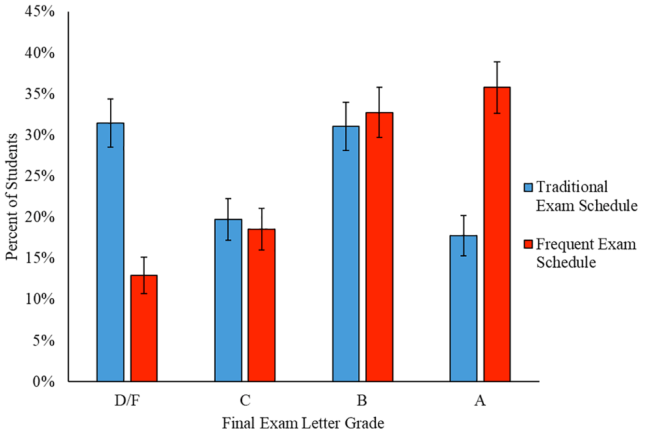
In a recently published paper, Jason Morphew and co-authors showed that frequent short PrairieLearn exams in the CBTF (Computer-Based Testing Facility) substantially increased student learning in TAM 251 (“Introductory Solid Mechanics”) at the University of Illinois. Most impressively, these learning gains were on an identical pen-and-paper final exam and there were improvements at both high and low grade levels.
Continue reading Paper: learning gains from frequent computerized exams Education at Scale