We’ve all done it. You set what seems to be a reasonable exam but then the average comes out to be an F grade and all the students start freaking out. The immediate call is to curve the scores up! I think this is generally a good idea, because students are conditioned to expect an average score around 70% to 80% for exams and they will be stressed if it is much below this. But now the question arises: “How exactly should we curve the scores?” Here I’ll show the super-simple MTM method that works well in practice.
Continue reading Simple exam-score curving with MTMHard questions should be worth less
IDC (inverse-difficulty credit) is a points scale for exams where hard questions are worth fewer points. This gives good grade distributions on exams using mastery grading, where questions are only graded as correct or incorrect.
Continue reading Hard questions should be worth lessStudent survey after the corona-semester
In the final week of the Spring 2020 semester, Elif and I collected anonymous survey results in our class Introductory Dynamics (TAM 212). This was the semester disrupted halfway through by COVID-19. Students reported that their biggest challenges were feeling disconnected from other people in their courses and staying engaged and enthusiastic. They also liked live lectures and having two professors, and they weren’t in favor of online exam proctoring. This class had 407 students and there were 68 survey responses (17% response rate). Read on for the details.
Continue reading Student survey after the corona-semesterOnline lectures should be live
As we move our lectures online due to COVID-19, I’ve been surprised to find that online lectures are much better if they are live, with students participating in real time, rather than pre-recorded. Live lectures are more fun to give, allow natural interaction and a sense of community, provide structure for students at home, and even open up some neat new interaction possibilities. Of course we also record these lectures so that students who can’t make the lecture time can still watch later.
Continue reading Online lectures should be livePaper: learning gains from frequent computerized exams
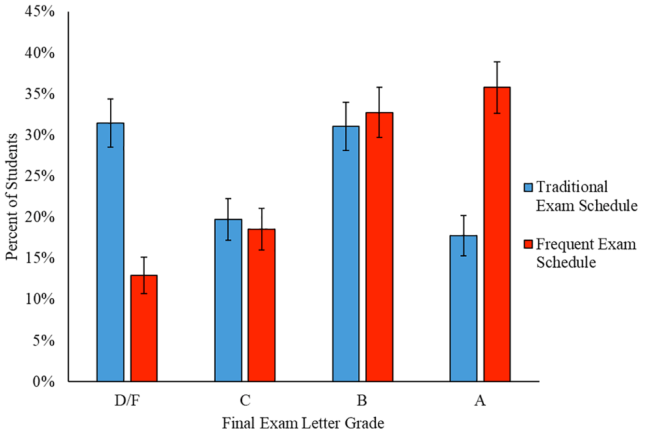
In a recently published paper, Jason Morphew and co-authors showed that frequent short PrairieLearn exams in the CBTF (Computer-Based Testing Facility) substantially increased student learning in TAM 251 (“Introductory Solid Mechanics”) at the University of Illinois. Most impressively, these learning gains were on an identical pen-and-paper final exam and there were improvements at both high and low grade levels.
Continue reading Paper: learning gains from frequent computerized examsComputer-Based Testing Facility (CBTF)
The first time I taught a large class (about 600 students in Calc II), I was totally unprepared for how much effort it took to simply run an exam, from room scheduling and proctoring to dealing with conflict exams (and conflict-conflicts and even conflict-conflict-conflicts). Then came grading, and re-grading, and student complaints about unfair TA grading. And all this doesn’t even include actually writing the exam!
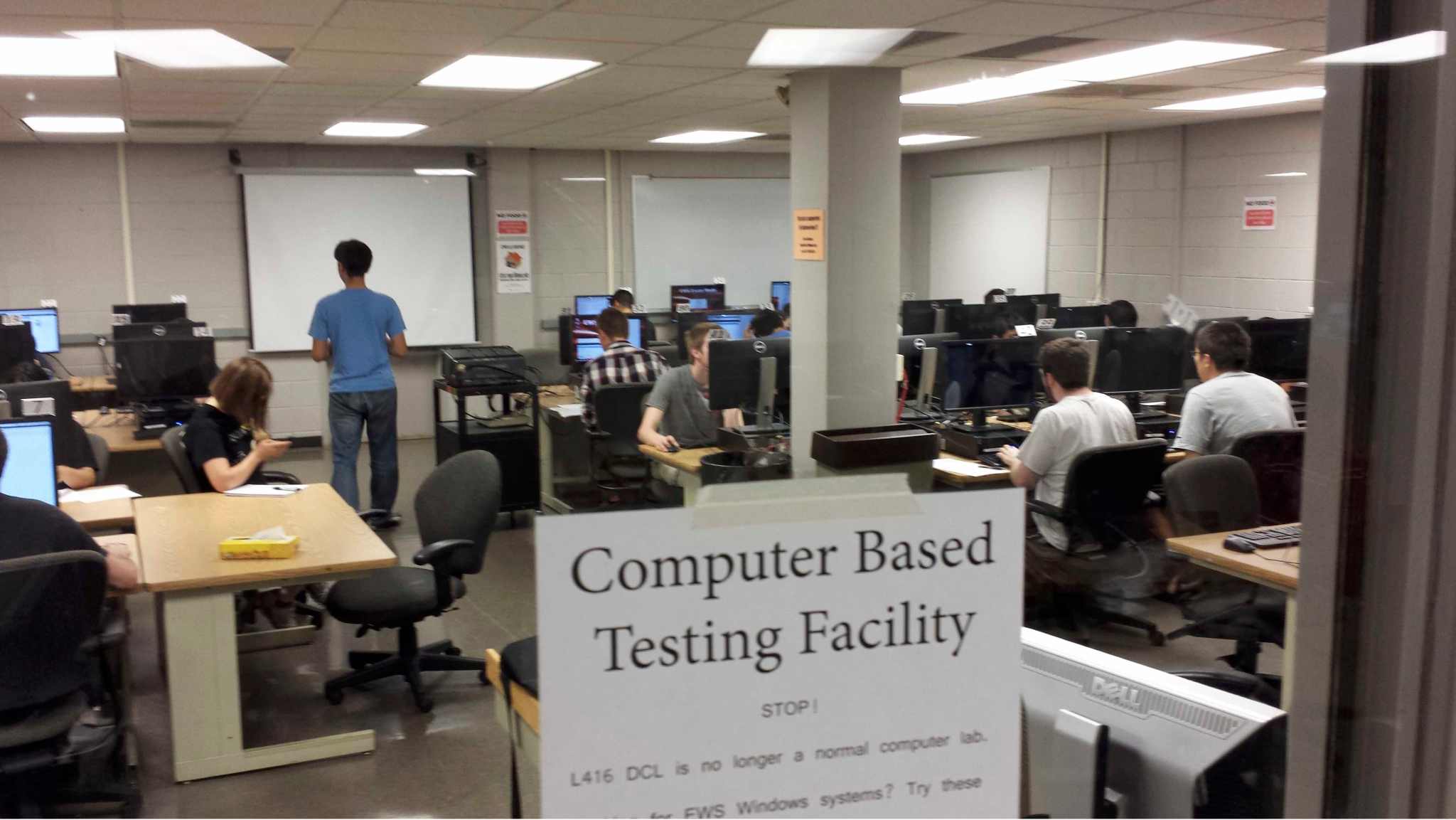
Now we are using fully-automated exams in the CBTF (Computer-Based Testing Facility), which is providing more authentic tests with dramatically improved logistics, as described below.
Tablets for lecturing
I grew up as a young professor lecturing on blackboards and I loved sliding sets of huge boards up and down and covering myself in chalk as I worked through a complex derivation. But these days I’ve fully converted to writing on a tablet and I can’t imagine going back, for many reasons that I explain below.
 Education at Scale